
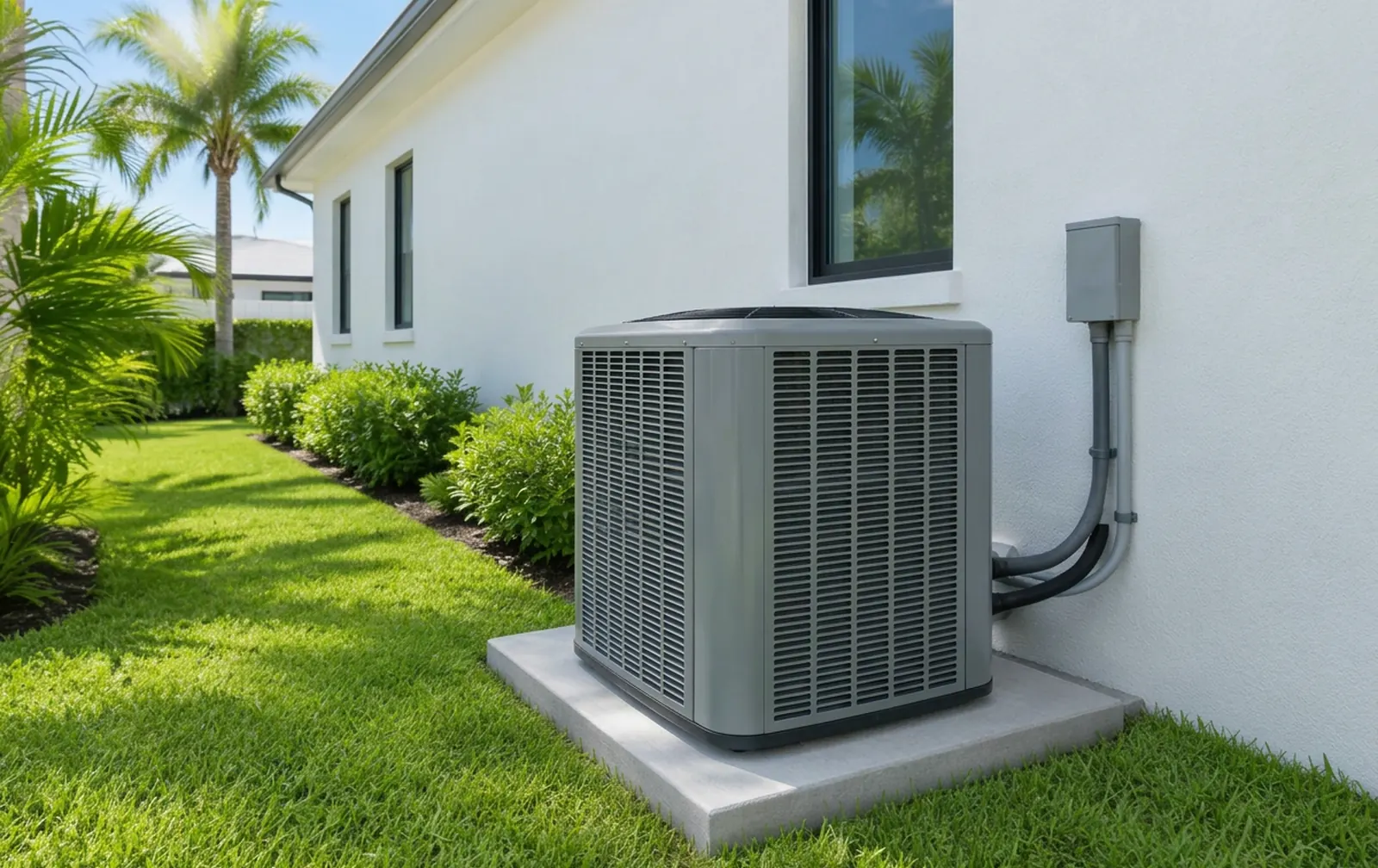
AC installation · South Florida
Air conditioning installation and replacement
A new system should be chosen for your space, your ductwork and the way South Florida humidity behaves — not just matched to the label on the old unit. We help you plan the replacement, install it cleanly and confirm it performs.
What you might notice
When it may be time to consider a new system
Frequent repairs
Several service calls in a short period often signal an aging system rather than one-off failures.
Major component failure
A failed compressor or leaking evaporator coil can make replacement worth comparing against repair.
Persistent humidity
If the house feels clammy even when it's cool, the system may be oversized or no longer removing moisture well.
Uneven rooms
Hot bedrooms and cold living areas can come from equipment, duct design or both.
Older refrigerant
Systems built around phased-out refrigerants become harder and more expensive to keep running.
Renovation or addition
Changing layout or adding square footage is a natural time to re-evaluate capacity and ducts.
Scope
What an installation project typically includes
- Reviewing the property, existing equipment, ducts and electrical
- Discussing capacity, efficiency options and humidity control
- Removing the old equipment and installing matched indoor and outdoor components
- Connecting drains, refrigerant lines, controls and thermostat
- Start-up checks and a walkthrough of operation and filter care
Exact work depends on what's found on site. We explain findings before starting.
Quick guide
What are you planning?
What kind of installation are you planning? Pick the closest match to see what we'd talk through and what a technician would check. This is a guide, not a diagnosis or a quote.
Questions to discuss
- Is the current system still running, or has it failed?
- Comfort issues you want the new system to fix
- Any changes to the space since the old unit went in
What a technician would evaluate
- Existing duct condition and sizing
- Electrical supply, disconnect and line set reuse
- Load factors: windows, insulation, occupancy, sun exposure
Your selection ("Replacing an existing system") is added to your request so we have context when we call.
Questions to discuss
- Square footage and how the space will be used
- Whether existing equipment could serve it
- Construction timeline and other trades involved
What a technician would evaluate
- Load calculation for the new space
- Ducted extension versus a separate system
- Equipment location, drainage and electrical
Your selection ("Addition or new space") is added to your request so we have context when we call.
Questions to discuss
- Which rooms need cooling
- Wall and ceiling space for indoor units
- Preference for visible heads versus concealed options
What a technician would evaluate
- Ductless mini-split zoning options
- Outdoor unit placement and line routes
- Whether a ducted system is practical
Your selection ("No existing ductwork") is added to your request so we have context when we call.
How it works
How a split AC system moves heat
The indoor coil absorbs heat from room air; refrigerant carries it to the outdoor unit, which releases it outside. Solid cyan: cooler side; dashed red: warmer side. Illustrative only, not an engineering design.
Point 1 of 5
Evaporator coil & blower
Room air passes over the cold coil; moisture condenses and drains away. Dirty coils or filters reduce airflow.
Diagram described in text
- Evaporator coil & blower: Room air passes over the cold coil; moisture condenses and drains away. Dirty coils or filters reduce airflow.
- Condensate drain: Removes water pulled from the air. Blocked drains are a common cause of indoor leaks.
- Refrigerant lines: Carry refrigerant between units. Leaks or damaged insulation reduce cooling.
- Compressor & condenser fan: Release heat outdoors. Failed capacitors, contactors or fans often stop cooling.
- Thermostat: Signals the system to run. Wiring or settings problems can look like equipment faults.
Making the call
Choosing between replacement and continued repair
Replacement is a significant decision. These are the questions we help you think through; we won't push a new system when a repair makes more sense.
- The issue is a single, inexpensive part
- The system has kept the property comfortable and dry
- You're planning to sell or renovate soon and need a bridge
These are common patterns, not a verdict on your equipment. We explain options after inspecting it.
- Repair estimates are approaching a significant share of a new system's cost
- Comfort and humidity problems have been ongoing
- The outdoor coil or cabinet shows heavy coastal corrosion
- You want different efficiency, zoning or control features
These are common patterns, not a verdict on your equipment. We explain options after inspecting it.
The visit
How a ac installation visit works
- 01
Request a consultation
Share your ZIP code and a few details. We'll contact you to set up an on-site visit.
- 02
Assess the property
We look at the space, existing equipment, ductwork and electrical, and listen to what isn't working for you.
- 03
Written options
You'll receive the recommended equipment and scope so you can compare before committing.
- 04
Installation and start-up
We install, test and walk you through the new system once it's running.
What to have ready
- Rough square footage and number of rooms
- Photos of the current indoor and outdoor units and labels
- Known comfort issues: hot rooms, humidity, noise
- Any HOA or building rules for outdoor equipment
What affects scope and cost
- System type and capacity the space actually needs
- Whether ductwork, electrical or a pad/stand must change
- Equipment location access (attic, closet, roof)
- Permitting and inspection requirements for the job
Good to know
- We don't quote replacements over the phone without seeing the site
- Bigger isn't better — an oversized system can feel clammy
- Equipment lead times vary and are confirmed when ordering
We don't publish prices: cost depends on what's found on site and is explained before work starts.
Coverage
Where we work
Installation and replacement consultations are available for properties in Miami, Broward County and Palm Beach County. Your ZIP code helps us confirm scheduling for your area.
See service areasAC installation questions
How do you decide what size system I need?
Capacity should be based on the property — square footage, insulation, windows, sun exposure and ductwork — rather than simply copying the old unit. We review these factors during the assessment.
Do I need new ductwork with a new AC?
Not always. We inspect the existing ducts. If they're leaking, undersized or damaged, we'll explain how that affects the new system so you can decide.
Can I replace only the outdoor unit?
Indoor and outdoor components are designed to work as a matched pair. Mismatched equipment can reduce performance, so we'll discuss what makes sense for your system.
Do you handle permits?
Permit requirements vary by municipality. We'll discuss what applies to your property during the consultation.
Will you remove the old equipment?
Removing the old unit is normally part of a replacement scope. We'll confirm the details in your written options.
Do I have to replace the indoor and outdoor units together?
Usually it's recommended, because matched components are designed to work together. We'll explain if a partial replacement is reasonable in your situation.
Will my existing ductwork work with a new system?
Often, but not always. We check duct condition, leakage and sizing; ducts that are undersized or damaged can limit what a new system can deliver.
Related services
- AC repairDiagnose and fix an air conditioner that isn't cooling, is short-cycling, leaking or making new noises.
- Duct installationInstall, replace or reconfigure ductwork to fix weak airflow, hot rooms and leaky or damaged runs.
- AC maintenanceRoutine tune-ups that keep drains clear, coils clean and small issues from becoming breakdowns.
Ready when you are.
Call to talk it through, or send a request and we'll follow up by phone. Serving Miami, Broward and Palm Beach.
Call (305) 433-7627