
Commercial & mechanical
Commercial HVAC service for occupied South Florida properties
Offices, retail, restaurants, medical suites and multi-tenant buildings can't simply switch off while the cooling is sorted out. We diagnose, repair, replace and maintain commercial air conditioning and central plant equipment, and plan the work around the people using the building.
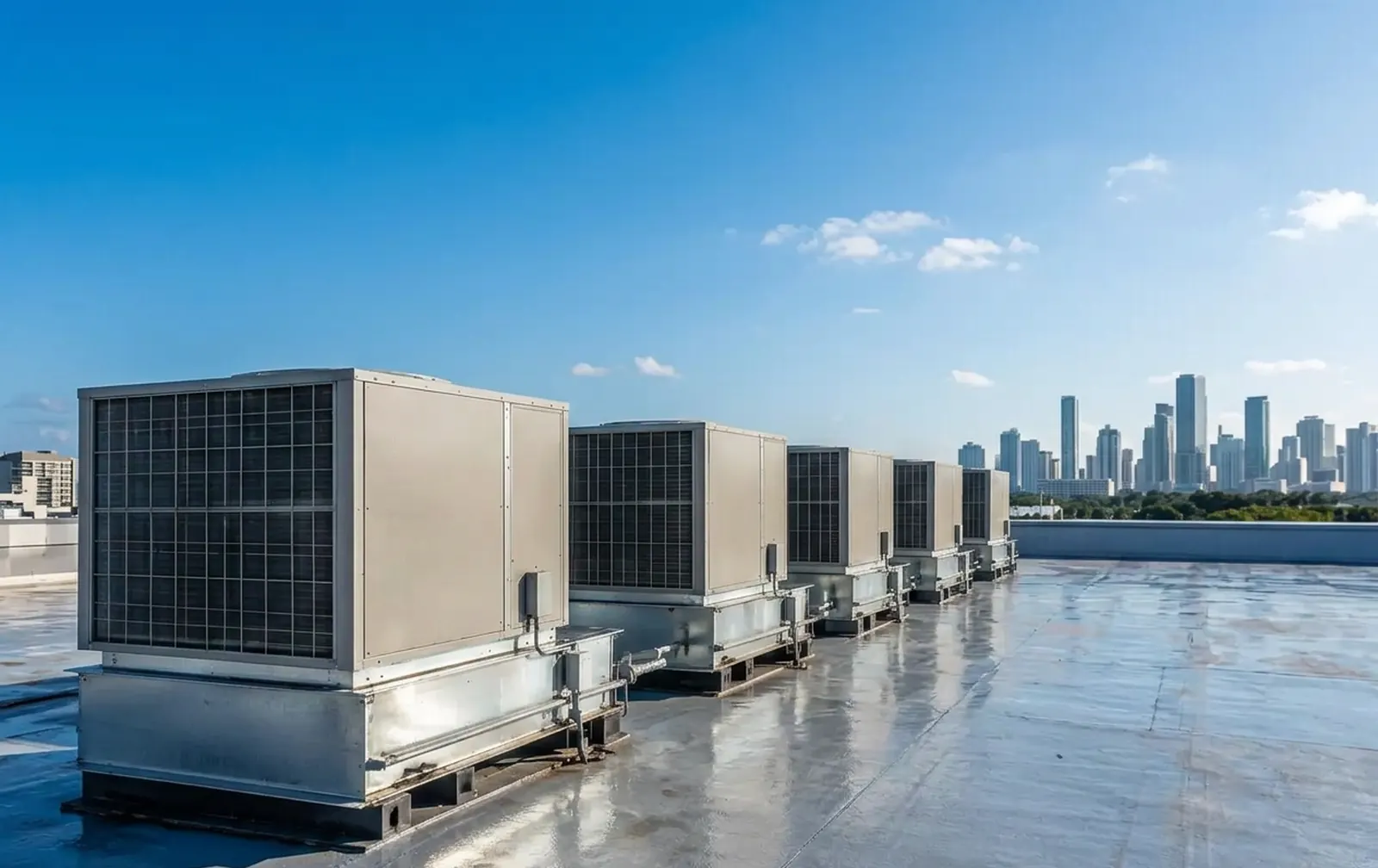
Packaged rooftop units
Rooftop units combine compressor, condenser, evaporator and supply fan in one cabinet, so a single fault can take a whole zone down. On South Florida roofs they also take direct sun, wind-driven rain and, near the coast, salt exposure.
- Compressor, condenser fan and supply blower faults
- Economizer and damper operation
- Belt, bearing and motor wear
- Curb, cabinet and condensate drainage issues
- Unit replacement planning, including crane and roof access coordination
Commercial split systems
Many tenant suites and smaller buildings run on split systems with condensing units on the roof or at grade and air handlers above ceilings or in mechanical closets. Long refrigerant line runs and shared drain routing are common sources of trouble.
- Refrigerant-side diagnosis and leak investigation
- Air handler, blower and coil service
- Condensate drains, pumps and overflow protection
- Matched replacement of indoor and outdoor sections
Evaporator and fan coil units
Fan coils served by chilled water, and evaporator coils in split equipment, sit inside occupied space. Dirty coils, failing motors, stuck valves and blocked drains show up quickly as complaints, odors or ceiling stains.
- Fan motor and control board replacement
- Chilled-water valve and actuator checks
- Coil cleaning and drain pan service
- Unit-by-unit condition notes for larger buildings
Controls and thermostats
Many 'the AC is broken' calls turn out to be a schedule, sensor or setpoint problem. We check controls alongside the equipment so the system does what the building actually needs.
- Thermostat and zone sensor replacement
- Schedules, setpoints and occupancy settings
- Coordination with existing building automation where present
Chillers and cooling towers
Larger buildings rely on central plant equipment. Our chiller and cooling tower pages cover diagnostics, replacement and the maintenance these systems need.
Quick guide
What do you need help with?
What does your building need? Pick the closest match to see what we'd talk through and what a technician would check. This is a guide, not a diagnosis or a quote.
Questions to discuss
- Areas affected and occupants
- Alarm codes or thermostat messages
- Roof access arrangements
What a technician would evaluate
- Unit operation, compressors and fans
- Economizer and controls
- Electrical and safeties
Your selection ("Rooftop or split unit fault") is added to your request so we have context when we call.
Questions to discuss
- Which zones and when
- Recent tenant fit-outs
- Building controls in use
What a technician would evaluate
- Airflow and zoning
- Thermostat/controls setup
- Equipment capacity versus load
Your selection ("Comfort complaints across zones") is added to your request so we have context when we call.
Questions to discuss
- Unit ages and repair history
- Budget cycle and timing
- Shutdown windows
What a technician would evaluate
- Like-for-like versus resized replacement
- Curb, crane and structural needs
- Phased replacement
Your selection ("Replacement planning") is added to your request so we have context when we call.
Questions to discuss
- Equipment list
- Current maintenance records
- Visit frequency
What a technician would evaluate
- Site-specific maintenance scope
- Condition documentation
- Priority issues
Your selection ("Planned maintenance") is added to your request so we have context when we call.
How it works
How a split AC system moves heat
The indoor coil absorbs heat from room air; refrigerant carries it to the outdoor unit, which releases it outside. Solid cyan: cooler side; dashed red: warmer side. Illustrative only, not an engineering design.
Point 1 of 5
Evaporator coil & blower
Room air passes over the cold coil; moisture condenses and drains away. Dirty coils or filters reduce airflow.
Diagram described in text
- Evaporator coil & blower: Room air passes over the cold coil; moisture condenses and drains away. Dirty coils or filters reduce airflow.
- Condensate drain: Removes water pulled from the air. Blocked drains are a common cause of indoor leaks.
- Refrigerant lines: Carry refrigerant between units. Leaks or damaged insulation reduce cooling.
- Compressor & condenser fan: Release heat outdoors. Failed capacitors, contactors or fans often stop cooling.
- Thermostat: Signals the system to run. Wiring or settings problems can look like equipment faults.
Making the call
Repair now, or plan a replacement?
Commercial decisions involve budgets, tenant schedules and lead times. We give you the information to make the call.
- The failure is isolated and parts are available
- The unit has a solid service history
- Replacement would need budget approval or lead time you don't have yet
These are common patterns, not a verdict on your equipment. We explain options after inspecting it.
- Major components are failing repeatedly
- Refrigerant or parts availability is becoming a problem
- Corrosion or structural deterioration affects the cabinet or curb
- Tenant comfort complaints persist across seasons
These are common patterns, not a verdict on your equipment. We explain options after inspecting it.
Process
How commercial hvac work is handled
- 01
Call or send details
Tell us the property type, equipment if known and what occupants are experiencing.
- 02
Coordinate access
We confirm the site contact, roof or mechanical room access and any tenant-sensitive areas.
- 03
Diagnose and document
Findings are explained to the site contact and summarised in writing.
- 04
Approve and complete
Work proceeds once approved, scheduled to limit disruption where possible.
What to have ready
- Equipment list or nameplate photos
- On-site contact and access instructions
- Tenant notification requirements
What affects scope and cost
- Equipment type and size
- Roof or mechanical-room access, cranes or lifts
- Work in occupied space and timing
- Controls integration
Good to know
- Large replacements need a site survey and written scope
- We coordinate but don't override building access or safety rules
We don't publish prices: cost depends on what's found on site and is explained before work starts.
Coverage
Across South Florida
Commercial HVAC requests are taken from properties in Miami, Broward County and Palm Beach County. Share your ZIP code and we'll confirm.
Service areasCommercial HVAC questions
What types of commercial properties do you work with?
Offices, retail, restaurants, medical and professional suites, multi-tenant buildings and similar occupied properties. Tell us about your site and we'll confirm fit.
Can work be scheduled outside business hours?
Ask when you call. Scheduling options depend on the job and our availability, and we'll be clear about what's possible before booking.
Do you provide written findings?
Yes. Commercial visits include a written summary of what was found and recommended, which is useful for owners, managers and budgeting.
Do you replace rooftop units?
Yes. Replacement planning includes equipment selection, curb compatibility, electrical, and roof or crane access coordination.
Do you service packaged rooftop units?
Yes — diagnostics, repair, replacement and maintenance for packaged rooftop units and split systems.
Can you work around tenants?
We plan access and timing with the property contact and keep disruption as small as practical.
Emergency line
24/7 emergency HVAC service
We answer emergency calls and dispatch technicians 24/7 across Miami, Broward and Palm Beach. We'll give you a realistic arrival estimate when you call.
Ready when you are.
Call to talk it through, or send a request and we'll follow up by phone. Serving Miami, Broward and Palm Beach.
Call (305) 433-7627