
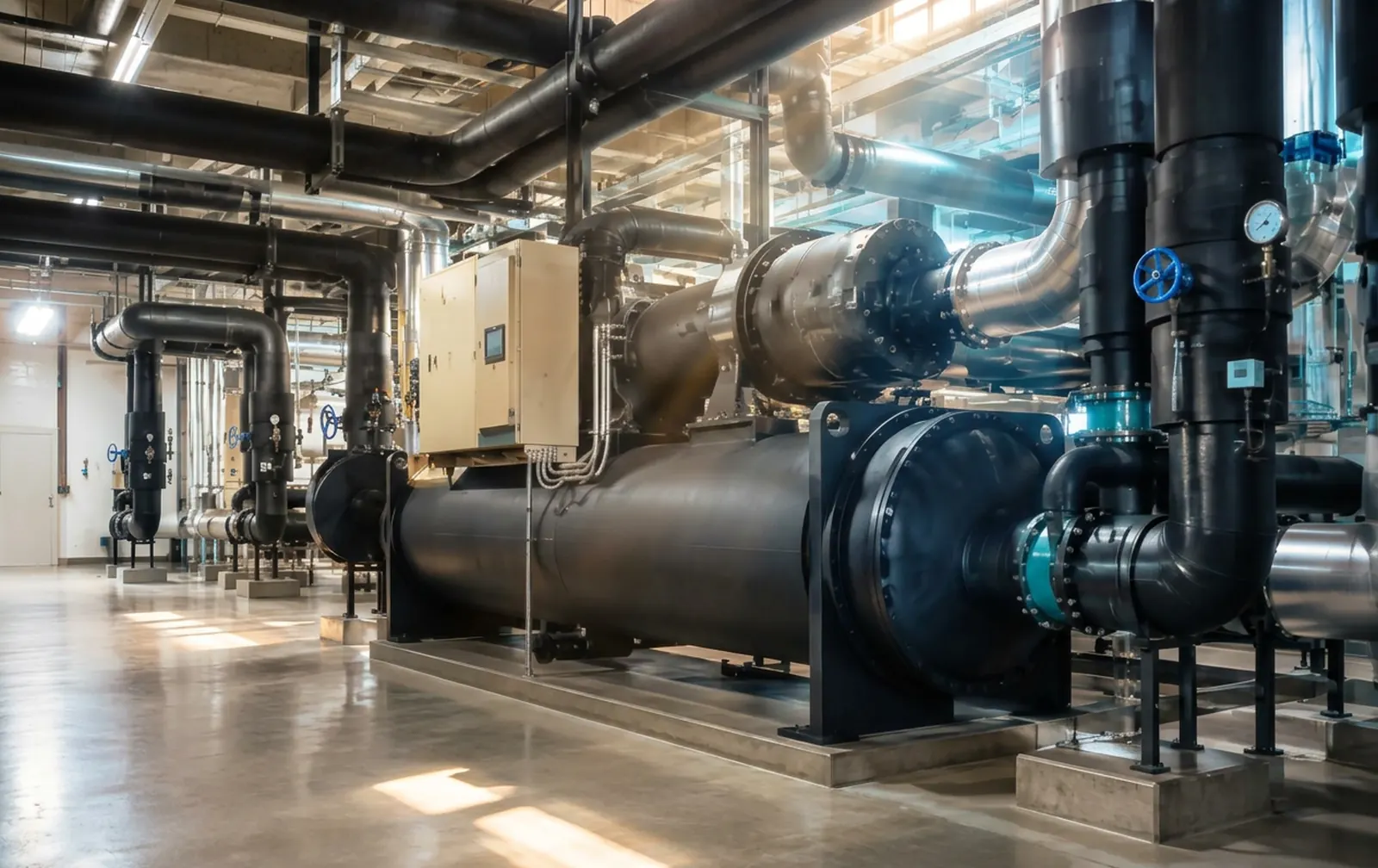
Chillers
Chiller diagnostics and repair
When a chiller trips, alarms or can't hold chilled-water temperature, the priority is understanding why — not resetting it and hoping. We work through the refrigerant, electrical, water-side and controls evidence to find the cause.
Common chiller problems
- High head pressure trips, often linked to condenser coil, tower or condenser water issues
- Low suction or low evaporator temperature alarms
- Chilled-water supply temperature drifting above setpoint
- Compressor failing to start, short-cycling or drawing abnormal current
- Oil pressure or oil temperature faults
- Flow switch trips from pump, strainer or valve problems
- Unusual noise or vibration
How we approach a chiller fault
We start with the alarm history and operating data, then check the conditions the chiller is seeing: water flows and temperatures on both sides, refrigerant pressures, and electrical supply. Many trips are caused by something outside the chiller — a tower fan, a closed valve, a failed sensor — and fixing that is quicker than replacing chiller parts.
If a component inside the chiller has failed, we explain what it is, what it affects and the lead time for parts, and discuss temporary measures where they're possible.
Quick guide
What do you need help with?
What's the chiller doing? Pick the closest match to see what we'd talk through and what a technician would check. This is a guide, not a diagnosis or a quote.
Questions to discuss
- Exact alarm code
- Time and load when it trips
- Whether it restarts after reset
What a technician would evaluate
- Alarm history and safeties
- Pressures, temperatures and flow
- Sensors and controls
Your selection ("Tripping on an alarm") is added to your request so we have context when we call.
Questions to discuss
- Leaving water temperature versus setpoint
- Building load changes
- Tower or condenser issues
What a technician would evaluate
- Evaporator and condenser approach
- Refrigerant charge indicators
- Condenser water and tower performance
Your selection ("Weak capacity / warm chilled water") is added to your request so we have context when we call.
Questions to discuss
- Where the noise comes from
- Oil or water on the floor
- When it started
What a technician would evaluate
- Compressor, motor and mounts
- Oil system
- Piping and seals
Your selection ("Noise, vibration or leaks") is added to your request so we have context when we call.
How it works
Chilled-water and condenser-water loops
The chiller cools water for the building; on water-cooled plants, condenser water carries heat to the cooling tower. Solid cyan: cooler side; dashed red: warmer side. Illustrative only, not an engineering design.
Point 1 of 4
Evaporator & condenser
Heat exchangers inside the chiller. Fouling or flow problems reduce capacity and trigger alarms.
Diagram described in text
- Evaporator & condenser: Heat exchangers inside the chiller. Fouling or flow problems reduce capacity and trigger alarms.
- Chilled-water loop: Cooled water serves coils across the building and returns warmer.
- Cooling tower (mechanical): Fans, fill and distribution reject heat. Water treatment is a separate specialist responsibility.
- Pumps, valves & controls: Maintain flow and sequence equipment; flow faults are a common trip cause.
Making the call
Repair or begin replacement planning?
A major chiller failure is a moment to look at the bigger picture. We'll share what we see so you can decide.
- The fault is in a replaceable component
- The chiller is otherwise in good condition
- Parts and refrigerant remain available
These are common patterns, not a verdict on your equipment. We explain options after inspecting it.
- Compressor or heat exchanger failures recur
- The refrigerant is being phased down and becoming costly
- Capacity no longer matches the building's load
- Maintenance records show steady decline
These are common patterns, not a verdict on your equipment. We explain options after inspecting it.
Process
How chiller repair work is handled
- 01
Call with the alarm
Share the alarm code or symptom and the equipment details if you have them.
- 02
On-site diagnosis
We review data and test the systems involved.
- 03
Explain and quote
You'll get the cause, the fix and parts lead times.
- 04
Repair and verify
After the repair we confirm stable operation at load.
What to have ready
- Alarm code and screen photos
- Operating logs
- Access to the plant room
What affects scope and cost
- Failed component and parts availability
- Need for refrigerant recovery
- Plant shutdown requirements
Good to know
- Don't repeatedly reset safeties — note codes and call
- Diagnosis requires on-site readings
We don't publish prices: cost depends on what's found on site and is explained before work starts.
Coverage
Across South Florida
Chiller repair requests are taken from properties in Miami, Broward County and Palm Beach County. Share your ZIP code and we'll confirm.
Service areasChiller repair questions
Our chiller keeps tripping on high pressure. What's likely?
Often it's the heat-rejection side: dirty condenser coils on air-cooled units, or cooling tower, condenser water flow or tube fouling on water-cooled units. A site visit confirms which.
Can you work on a chiller that's still under manufacturer warranty?
Warranty terms vary by manufacturer. Check your warranty documentation first and tell us about it when you call.
Is chiller trouble an emergency?
If the building depends on it and it's down, treat it as an emergency and call (305) 433-7627 — we answer emergency calls and dispatch technicians 24/7.
Can you work on chillers in occupied buildings?
Yes. We coordinate with building staff to manage cooling interruptions.
Should I keep resetting a tripping chiller?
No. Repeated resets can hide a fault or cause damage. Record the alarm code and call.
Ready when you are.
Call to talk it through, or send a request and we'll follow up by phone. Serving Miami, Broward and Palm Beach.
Call (305) 433-7627