
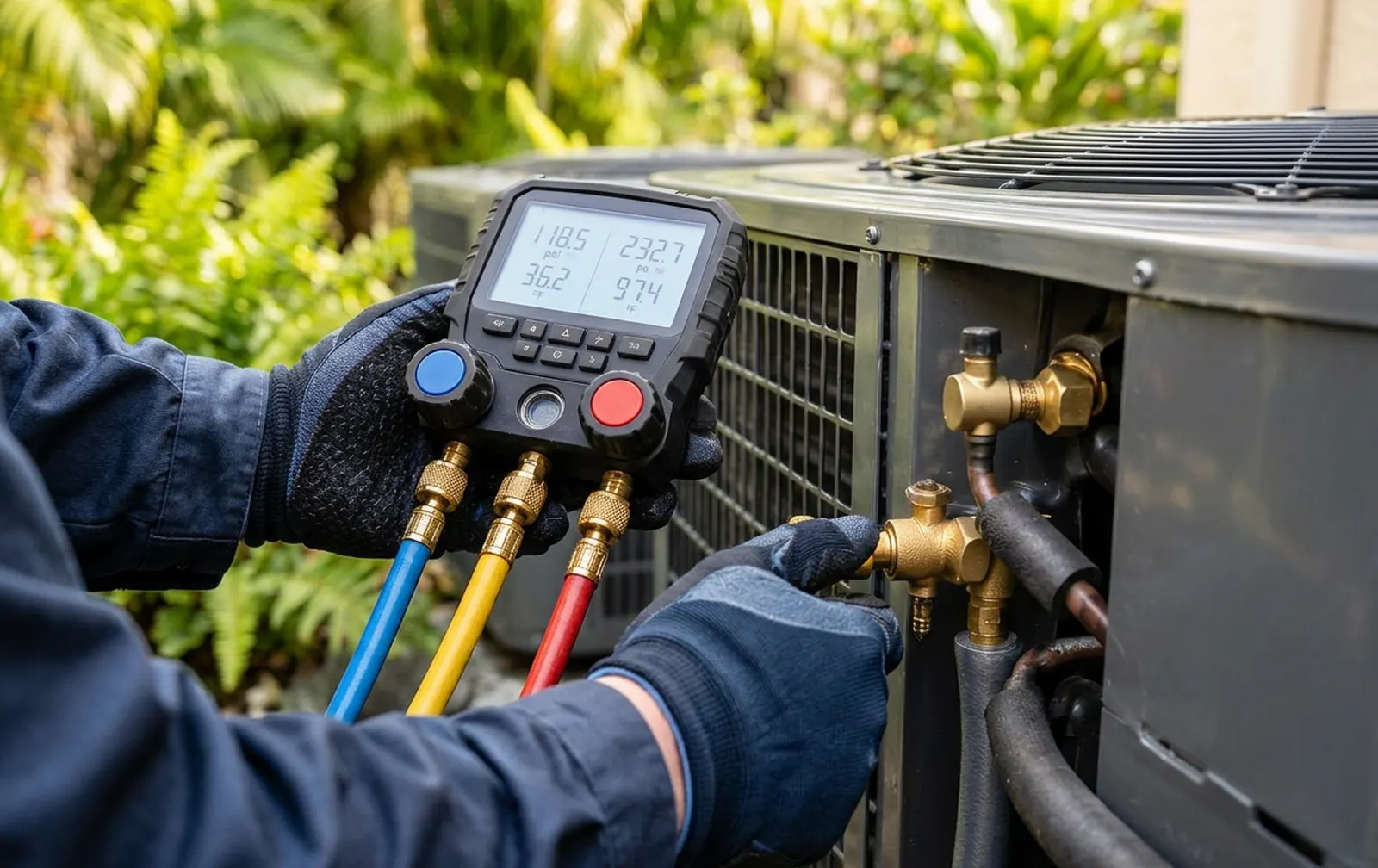
AC repair · South Florida
AC repair across Miami, Broward and Palm Beach
When the air coming from your vents feels warm, the system runs without stopping, or the indoor unit is suddenly dripping, you need a clear diagnosis before anyone replaces parts. We start by finding what's actually wrong and explain it in plain language.
What you might notice
Signs your air conditioner needs attention
Air isn't cold
The fan runs but supply air feels lukewarm, or the house never reaches the thermostat setting on a humid afternoon.
Short-cycling
The system turns on and off every few minutes. This can point to an electrical, airflow, sizing or thermostat issue.
Water where it shouldn't be
Drips near the air handler, a wet ceiling stain or a full drain pan often trace back to a clogged condensate line.
Ice on lines or coil
Frost on the copper refrigerant line or indoor coil usually signals restricted airflow or a refrigerant problem.
New noises or smells
Buzzing, grinding, rattling or a burning smell are worth switching the system off and calling.
Outdoor unit won't start
If the indoor fan runs but the condenser stays silent, a capacitor, contactor or breaker may be involved.
Scope
What a repair visit can address
- Electrical components such as capacitors, contactors and fan motors
- Clogged condensate drains, float switches and overflow shut-offs
- Airflow restrictions from dirty filters, blower issues or blocked returns
- Thermostat wiring and settings that keep the system from responding
- Refrigerant-side concerns, including leak checks where the findings warrant it
Exact work depends on what's found on site. We explain findings before starting.
Quick guide
What do you need help with?
What is your air conditioner doing? Pick the closest match to see what we'd talk through and what a technician would check. This is a guide, not a diagnosis or a quote.
Questions to discuss
- Is the outdoor unit running when the indoor fan is on?
- Did it cool less gradually, or stop suddenly?
- When was the filter last changed?
What a technician would evaluate
- Refrigerant-side pressures and temperature split
- Capacitor, contactor and condenser fan operation
- Coil condition and airflow across the evaporator
Your selection ("Running but not cooling") is added to your request so we have context when we call.
Questions to discuss
- Where the water appears: air handler, ceiling or closet floor
- Whether a float switch has shut the system off
- If the drip started after recent work or a storm
What a technician would evaluate
- Condensate drain line, trap and pan
- Float/safety switch operation
- Coil icing that can overflow when it melts
Your selection ("Water leaking indoors") is added to your request so we have context when we call.
Questions to discuss
- How long it runs before stopping
- Any breaker trips or thermostat blank screens
- Thermostat changes or power outages recently
What a technician would evaluate
- Thermostat signal and wiring
- Electrical components and safety controls
- Airflow restrictions and system sizing clues
Your selection ("Short-cycling or won't start") is added to your request so we have context when we call.
Questions to discuss
- Type of sound: rattling, buzzing, squealing, hissing
- Indoor or outdoor unit
- Any burning smell (switch off and call)
What a technician would evaluate
- Fan motors, blades and mounts
- Electrical connections for heat or arcing signs
- Compressor start and running behaviour
Your selection ("New noise or smell") is added to your request so we have context when we call.
How it works
How a split AC system moves heat
The indoor coil absorbs heat from room air; refrigerant carries it to the outdoor unit, which releases it outside. Solid cyan: cooler side; dashed red: warmer side. Illustrative only, not an engineering design.
Point 1 of 5
Evaporator coil & blower
Room air passes over the cold coil; moisture condenses and drains away. Dirty coils or filters reduce airflow.
Diagram described in text
- Evaporator coil & blower: Room air passes over the cold coil; moisture condenses and drains away. Dirty coils or filters reduce airflow.
- Condensate drain: Removes water pulled from the air. Blocked drains are a common cause of indoor leaks.
- Refrigerant lines: Carry refrigerant between units. Leaks or damaged insulation reduce cooling.
- Compressor & condenser fan: Release heat outdoors. Failed capacitors, contactors or fans often stop cooling.
- Thermostat: Signals the system to run. Wiring or settings problems can look like equipment faults.
Making the call
Repair or replace? Factors worth weighing
No one can promise an outcome before the system is inspected. These are the factors we walk through with you so the decision is yours and well-informed.
- The failed part is isolated and the rest of the system is in reasonable condition
- The equipment is relatively young and has been maintained
- The repair cost is modest relative to the value of the system
- Comfort was good until a recent, specific failure
These are common patterns, not a verdict on your equipment. We explain options after inspecting it.
- Repeated breakdowns or a major component like the compressor has failed
- The system uses a phased-out refrigerant that makes repairs costly
- Rooms have been uneven or humid for years, not just recently
- Visible corrosion on coils or cabinets from coastal air
These are common patterns, not a verdict on your equipment. We explain options after inspecting it.
The visit
How a ac repair visit works
- 01
Tell us what's happening
Call or send the short form with your ZIP code and what you're noticing. We'll follow up to arrange a visit.
- 02
On-site diagnosis
A technician checks electrical, airflow, drainage and refrigerant indicators and explains the findings.
- 03
Clear options before work
You'll hear what we found and what we recommend before any repair begins.
- 04
Repair and verify
After the work, we confirm the system is running and cooling as expected before we leave.
What to have ready
- Thermostat make/model and current settings
- Approximate age of the system if known
- Clear access to the indoor unit and outdoor condenser
- Any error codes or recent service paperwork
What affects scope and cost
- Which component has failed and whether parts are readily available
- Refrigerant type the system uses and whether a leak must be located
- Access: attics, closets, rooftops or tight equipment rooms
- Whether more than one fault is present
Good to know
- We confirm a diagnosis on site; online symptoms are only a starting point
- Don't open electrical panels or refrigerant lines yourself — switch the system off and call
- Repairs on very old systems may be uneconomic; we'll say so plainly
We don't publish prices: cost depends on what's found on site and is explained before work starts.
Coverage
Where we work
We take AC repair requests from properties in Miami and throughout Miami-Dade, across Broward County, and in Palm Beach County. Share your ZIP code and we'll confirm availability for your location.
See service areasAC repair questions
My AC is running but not cooling. What should I check first?
Make sure the thermostat is set to cool and the setpoint is below room temperature, replace a dirty filter, and confirm the outdoor unit is running and its breaker hasn't tripped. If it still isn't cooling, switch the system off to avoid icing and request service.
Should I turn the system off if I see ice?
Yes. Running a frozen coil can strain the system. Turn the cooling off, leave the fan on to help it thaw, and contact us so we can find the cause.
Do you tell me the price before repairing?
We explain what we found and the recommended work before starting so you can decide. We don't publish prices online because they depend on the diagnosis.
Can you repair any brand?
Most common residential and light-commercial split systems can be serviced. Tell us the brand and model in the form if you know it, and we'll confirm.
Is a leaking indoor unit an emergency?
Water can damage ceilings and floors, so switch the system off and place a container under the drip if safe. A clogged drain line is a frequent cause and is usually straightforward to clear.
Should I keep running an AC that's blowing warm air?
Usually no. Running it can freeze the coil or strain the compressor. Switch cooling off, leave the fan setting alone, and call so a technician can check it.
Can you repair any brand?
We work on common residential and light-commercial split systems and packaged units. Tell us the brand and model when you call so we can confirm parts and approach.
Related services
- AC installationPlan and install a new or replacement air conditioning system sized for your property and Florida humidity.
- Duct installationInstall, replace or reconfigure ductwork to fix weak airflow, hot rooms and leaky or damaged runs.
- AC maintenanceRoutine tune-ups that keep drains clear, coils clean and small issues from becoming breakdowns.
Emergency line
24/7 emergency HVAC service
We answer emergency calls and dispatch technicians 24/7 across Miami, Broward and Palm Beach. We'll give you a realistic arrival estimate when you call.
Ready when you are.
Call to talk it through, or send a request and we'll follow up by phone. Serving Miami, Broward and Palm Beach.
Call (305) 433-7627